

Three reasons to adopt Astry before your next incident
Most organizations only think about their alerting setup after they've needed it. A server down at 3am, a cyberattack detected over the weekend, a physical security incident in the middle of the night: in those moments, every minute counts, and the question that immediately arises is always the same: who do we notify, how, and in what order?
And more often than not, the crisis passes — and we forget to prepare for the next one.
Astry is a platform designed to answer exactly that question. But beyond the purely technical use case, Astry addresses a much broader range of organizations. Here are three concrete situations where Astry provides a direct answer that is very quick to put in place.
1. Reaching the person who needs to act during a critical incident
This is Astry's founding and most established use case. You operate digitized services (cloud infrastructure, critical APIs, embedded systems, online services, ...) and you need to ensure that when an incident occurs, the person or people capable of acting are reached immediately, whatever the circumstances.
The organizations involved are varied:
- Infrastructure and IT service operators (startups, scale-ups, software publishers, telecom operators, IT service companies) who have on-call technical teams and need a reliable tool to orchestrate rotations and escalations, and to reach those teams through the right channel (SMS, voice call, mobile push, email, Microsoft Teams, ...).
- Freelancers and small organizations who monitor systems on behalf of their clients and want to professionalize their alerting setup without deploying heavy infrastructure.
- Service companies and integrators who want to expand their offering by distributing Astry to their own clients. Astry can become a building block of your managed services catalogue — and also allow you to offer advisory services to your clients on this critical topic.
What sets Astry apart in this use case is the simplicity of describing the routing chain: each alert automatically escalates to the right team, then to the right person, via the right channel, according to rules you define once and that apply deterministically. No more manual transfers, no more oversights, no more uncertainty about "who is on call tonight", "who was called", "who are their backups", "how long do we have to restore the service", ...
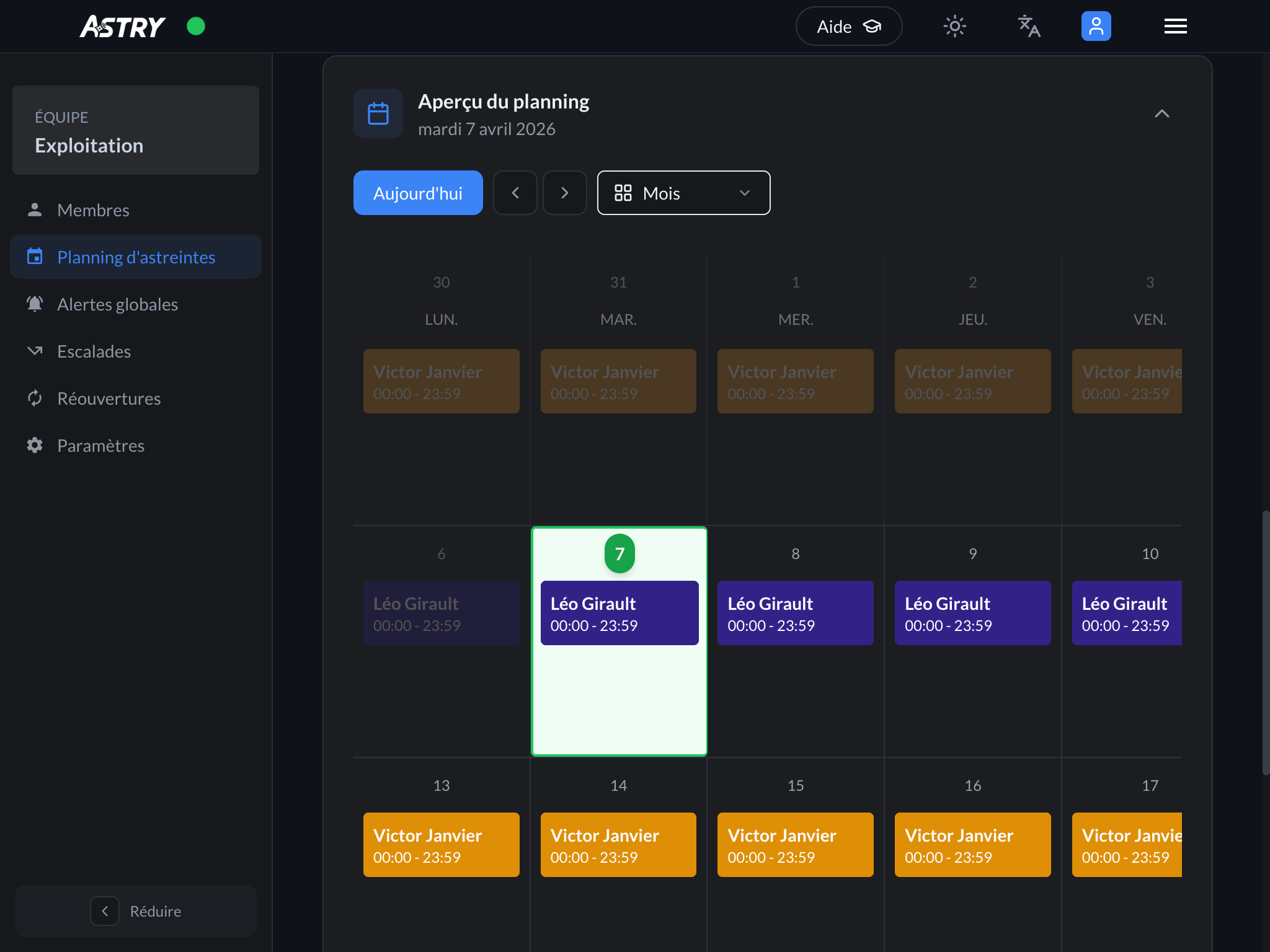 On-call schedule example
2. Communicating simply during a crisis
Incidents are not only technical in nature. A data breach, an on-site accident, a power outage, a physical threat, a cyberattack with business impact: all of these situations require notifying the right stakeholders, with the right message, and often under time pressure.
Yet in the majority of organizations, this process is either nonexistent, or defined in a PDF document that is rarely consulted and never tested. When the crisis hits, everyone improvises.
Astry makes it possible to structure this process by defining in advance:
- Based on the nature of the crisis (injured employee, cyberattack, fire, ...)
- Who must be contacted (management, security team, legal department, external communications, partners, authorities...)
- Via which channel according to each recipient's preferences
The stakes for an executive are twofold:
- On one hand, reducing reaction time by avoiding number lookups, disorganized email chains and cascade calls.
- On the other, guaranteeing traceability (who was notified, when, and acknowledged receipt) — which facilitates post-crisis actions (incident report, corrective measures, ...).
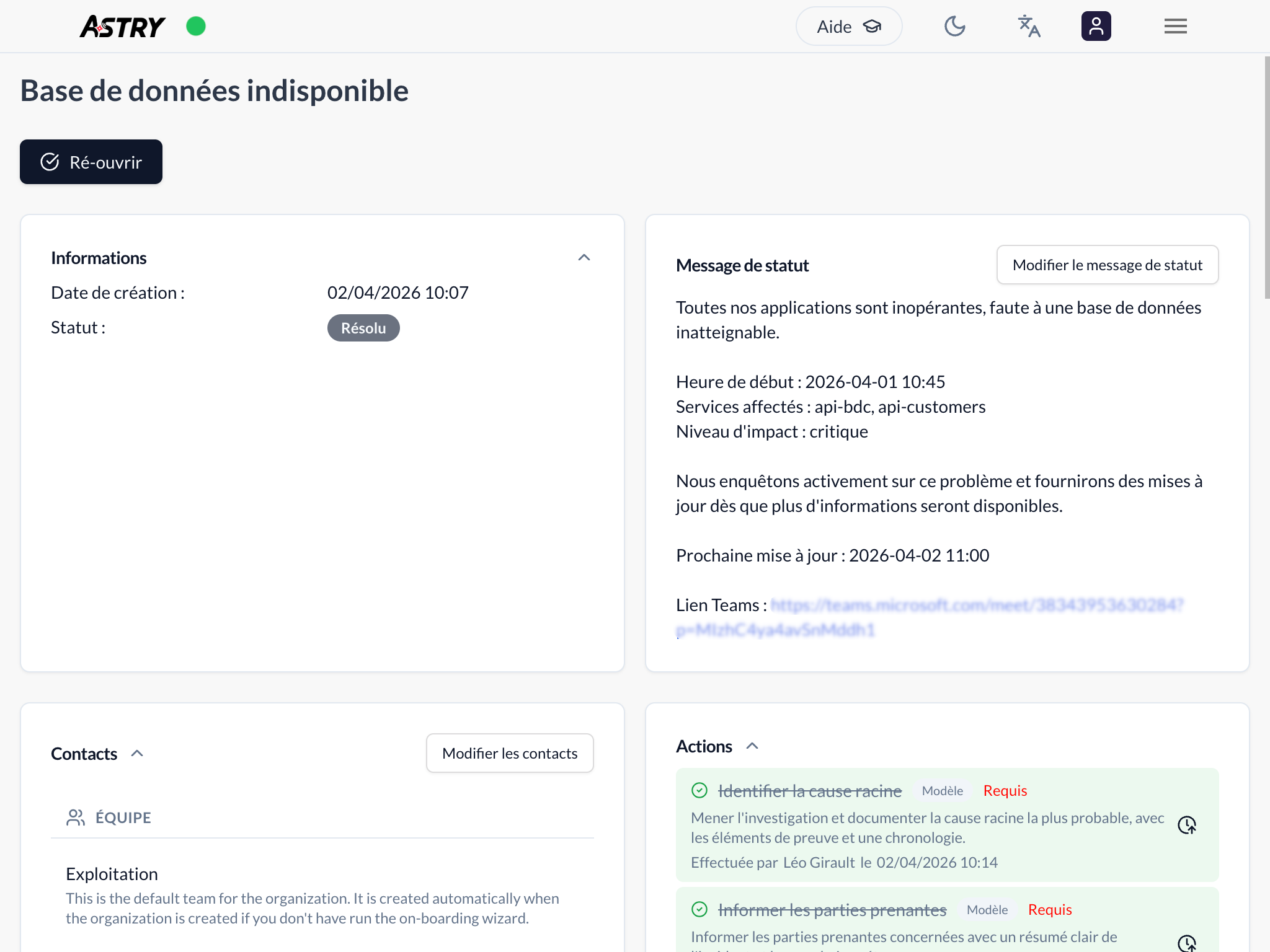 Crisis tracking: the subject, contacts, actions and events related to the crisis are logged and visible in the crisis monitoring page.
This use case applies to a very wide range of sectors: industry, healthcare, local authorities, retail, transport...
3. Laying the foundations of a Business Continuity Plan (BCP)
A BCP is often perceived as a long, costly undertaking reserved for large organizations. The reality is that many SMEs and mid-sized companies need to demonstrate a BCP approach (to their insurers, shareholders, major clients, or as part of certifications such as ISO 27001 or NIS2) without having the resources to deploy a full-scale solution.
Astry is a concrete, immediately operational first step. With no additional infrastructure and no complex integration, you can:
- Formalize alert chains for your critical processes
- Define the key people to contact in the event of a business disruption
- Regularly test these chains through simulation exercises
- Produce activity reports that attest to the functioning of your setup
- Store, retrieve and securely use (end-to-end encryption, manual or automated deposit via API) the documents needed to keep the business running even if none of the organization's usual tools are available
For an executive, project manager or team lead who needs to justify a BCP approach, Astry offers a pragmatic lever: start somewhere, with a simple tool, without waiting to have everything formalized. A BCP does not need to be perfect to be useful — it needs to be real and tested.
One platform, three entry points
These three use cases share the same foundation: the certainty that the right information reaches the right person at the right time. Whether it is a technical incident, an operational crisis or a BCP exercise, the underlying problem is identical.
Astry was designed to address it in a simple, reliable and adaptable way — whether you are a freelancer, a ten-person startup, or an industrial company with thousands of employees.
If any of these use cases resonates with your situation, you can get started for free or contact us directly to discuss your specific needs.
Keywords: SLA, SLO, BCP, on-call, crisis, incident response, run, escalation.